Why Write?

This oft asked question is reliably put to any established or aspiring author: why write? To which I answer:

Why not?

Now that I’ve answered that question with a pithy remark, here’s a better answer: Writing, to me, is the manner in which I reconcile the world around me. Shit happens and I find it deeply absorbing to find a place for it in a story. Why a story? Because stories are wrapped around characters and the best evoke human sympathies, connections, and revulsions. It is far more interesting to learn of an age through a well-written story.

And this is our age.

I find that writing allows me to explore themes and ideas, whether about love and corruption, loss and redemption, or of the pervasive nature of individualism over community; personal avarice over common good. Weaving these themes into stories with flawed characters is a great way to pass the time.

That’s not to say it’s easy. It’s often a great deal of work, of re-writing, of editing, and occasionally it’s sleepless nights when you’re sure you just wasted many hours on what is essentially crap. That’s where alcohol comes in, but we’ll set that aside for now.

The other reason I write is to leave a tangible piece of me behind after I shuffle off to wherever we shuffle off to when our days on the big blue marble are over. Nothing stands in better stead than what we write.

There’s also the not so insignificant opportunity to do, at least mentally, all the interesting and terrible things we dare not do in real life. Or to imagine ourselves as someone or something we know we would or could not be, again, in, as Nigel Tufnel would say, our dreary little lives.

We can work out our problems with those we know in ways that actually end in resolution rather than stalemate or detente as real life often does. There’s the added bonus of whether we’ll be caught in the act.

“This is about me, isn’t it?” will be asked a time or two by those reading our nifty little stories. And whether we own up or coyly deflect, gives us another reason to continue on in our dreary little lives. Note that the resolution need not be affirming for all parties.

And lastly, there is the thrill of finding out whether you can pull it off, if you can indeed write something others will profess to love, or at least not grimace over. Sure, you can fall on your ass, and that can hurt, but if you don’t try, what’s the point?

Exactly.

©2019 David William Pearce

Moses and the Soil

Moses is Monk’s father, who, along with the Mackinaw brothers founded the commune where Monk grew up. Moses and Monk do not see eye to eye on many things. This is from earlier in Monk’s life, when he was young and still living on the farm.

“Take it in your hand, take hold of it.” Moses took a handful of dirt from where I stood and put it in my hands. “Feel that? Compress it; run it through you fingers; smell it; it is the foundation of our lives, the soil that forms our bodies, our connection to Mother Earth!”

Yeah, yeah, yeah!

I didn’t care. It had been a long day and I was tired. What I wanted was to go into town and have a cheeseburger platter at the Big Boy, not stand here with a handful of dirt! I’d had more handfuls of dirt pushed on me than I could stand. I made a solemn vow then and there to never be a tiller of the land or a guardian of the soil or a goddamned farmer!

“Sunshine!” The old man was glaring at me.

“What?”

The exasperation within him was manifest. Moses Bohrman contemplated me, his first born, as he had so many times before. “Do you hear a word I say?”

“Yeah, earth, dirt; I get it, love the land.”

“Love the land,” he mimicked.

“That’s what you tell me isn’t it?”

He sighed. “You don’t hear anything I say, do you? I imagine the only thing in your head right now is running off with Miguel and James so the three of you can get into more trouble.”

“What’s that supposed to mean?”

Moses’ face tightened. “What does that mean? You know exactly what that means! You don’t think I know what the three of you are up to? People talk, you realize that, don’t you? Do you honestly think you can keep screwing around without consequence? You’re going to end up in jail, you know that right?”

“It’s not like that,” I equivocated, knowing full well he was probably right.

“It’s exactly like that! When are you going to grow up! I also heard you’re running around with some girl in town; are you being responsible?”

“What do you mean responsible?”

Moses stood there aghast. “What do you think I mean? Do you honestly think you’re ready to be a father?” The veins on his forehead were throbbing.

“It’s not like that…”

“Are you using birth control? Do we need to get you some?” I was surprised by how adamant he was.

“It’s not like that,” I mumbled. It was too late for that.

We stood there upon the dirt. I could see his anger and frustration fade into disappointment, which I considered his default opinion of me.

“I don’t understand,” he said as he took my hands and brushed the dirt from them, “you’re not an idiot, I know inside you there’s a bright young man. I know you have promise, but you seem bound and determined to throw it away…” Moses held my hands tight. “I don’t know what to do with you and it’s obvious you have little interest in the gravity of what you do…”

“It’s not like that!” He was making me angry.

He let go of my hands.

“Then what is it like, Sunshine?”

“Please don’t call me that, it’s a stupid name!”

“Why is it a stupid name?” We’d had this argument many times.

“It’s something you’d call your dog,” I shouted.

“You don’t have to yell and I think you’re wrong; it a beautiful name…”

“They laugh at me because it’s a joke, like, like…if… you might as well have named me bumblebee!”

We heard laughter. Sterling, my six-year-old half-brother, was standing about ten feet from us.

“Bumblebee’s funny, Daddy,” he said.

“See,” I pointed at Sterling, “everyone’s laughing.

Moses shook his head. “It’s a beautiful name.”

“It’s only beautiful to you!”

I left him there.

There was nothing else to say.

©2019 David WIlliam Pearce

Main Character, Too Much? Too Little?

Book series with a reoccuring main character in the thriller/mystery/crime genre generally revolve around two types: the evolving character and the static character.

The evolving character starts and grows, one hopes, over the course of the series, where the other is known only to a slight degree, meaning some background, but that’s all, and is basically an observer, even as he or she solves the crime or mystery.

As examples, I offer Easy Rawlins and Philip Marlowe. I offer them because both played inspirational roles in the creation of my main character, Monk Buttman.

Philip Marlowe, a private detective in LA from the 1930’s through the 1950’s, is something of a cypher, we know and learn little about him over the course of the novels Raymond Chandler has written. This is by design. Marlowe is our oracle, the dispassionate voice chronicling the world in which we live, which is best described in the violence we do to one another. Marlowe’s world is corrupt and venal, justice is a fiction favored by those who can afford it.

The rest fear it.

He is a loner. There are no wives or girlfriends, only his opinion of the women he encounters. He’s educated and a former employee of the DA. That’s it. No history beyond that. Like Perry Mason, of the TV series, he is his work; there is nothing else.

Walter Mosley’s Ezekiel “Easy” Rawlins is the opposite of Marlowe in that he is a whole person. We know his history, from his childhood in Louisiana, to his service in WWII, to his move to Watts, where the first book begins. We also learn what life in LA, during the 1940’s through the 1960’s, was like for this black man in particular, and African Americans in general during that period. We travel with him through love and loss, children acquired, as well as property and a modicum of wealth. But like the rest noted above, he has no faith in justice; justice is for whites.

That both Marlowe and Rawlins inhabit the same place at roughly the same time offers both the similarities and dissonance between them. Racism for Marlowe is casual and simply a part of the landscape; he sees it and accepts it because there is no direct impact to him. This is not true for Rawlins. Racism is ever present, fused into every moment and interaction; it is inescapable. Both bare the brunt of police corruption, but where Marlowes accepts this too, there isn’t the very real terror in his encounters that there are for Rawlins. Rawlins is filled with anger by the constraints forced on him because of his race and the care his must take anytime he comes in contact with the police. Mouthing off as Marlowe might would only get him beaten or killed.

The irony is that both Marlowe and Rawlins know the system is rigged, that it is rotten at its core, that beautiful houses and well-trimmed lawns don’t change that dynamic, or that fine clothes can’t hide the stench of corruption, yet because we know so little of Marlowe and so much of Rawlins, how it affects them is so very different.

And that’s the beauty of these two different paths the authors have taken. One is observational, the other personal, even as they solve cases that are very much the same. The reader is then drawn in for their own reasons; to be drawn in or to observe.

©2019 David William Pearce

A Day on the Job

Monk’s job is as a courier/go-between/contact man for the law firm Aeschylus and Associates. In that capacity, and because their clients are somewhat eccentric, he often finds himself in, for him, interesting situations.

“Yes?” A fairly stiff older gentleman was less than excited with my ringing the doorbell. I, on the other hand was rather amused.

“I’m from Aeschylus and Associates,” I informed him.

“And?”

Apparently he would need more.

“Is there a Torvas Takalagas here? This is the address I was given, and while I’m sure you’re interested in my intentions, I’m afraid I can only speak to Mr. Takalagas.”

“And yet you feel the need to speak to me.” A wan grin crossed the old man’s face.

I had no answer for that.

He allowed me in and pointed to an alcove by the door. “Please wait here.”

He left, I assumed, to inform Mr. Takalagas.

I waited as voices carried down the long hall.

“Why is a man from Aeschylus and Associates here?” the man who greeted me demanded loud enough that I could hear.

“I have some documents for him to take. I’m allowed to do that, am I not?” This from whomever the old man was talking to.

“I made it clear to you that no correspondence would pass from this house without my say-so…” There was a momentary pause before the old man continued, “You expected me to be out of the house, didn’t you?”

“I think you’re overreacting; I don’t actually remember if you had a reason to leave or not. This is a personal matter that does not concern you.”

“Everything that happens in this house concerns me, Rodger!”

Rodger!

I looked again at the note I had with the address. I quietly opened the door and checked the number on the house. It matched my notes.

The conversation continued.

“We had an agreement, Rodger, an agreement about conduct and communication. I want to know exactly why that man is here!” the old man’s voice was becoming strained.

“Bellow a little louder, Alan, that way the neighbors can hear you too!”

It was good to have names now to go with the voices, which became muted after Rodger’s admonition. The house, however, was acoustically alive and continued to carry their quieter conversation throughout this part of the foyer where I was standing.

“Why is he asking for Torvas Takalagas? Why did you give him that name?” Alan was asking.

“Why not? You’re quite defensive today, Alan. I’m surprised. It’s just business and that name is associated with our business, is it not?”

“It’s a private name! I don’t want some office flunky knowing that name!”

“Office flunky? Oh come on, Alan, do you honestly believe Aeschylus and Associates would send over an office flunky? I’m sure the man has been properly vetted. Better yet, he’s still here, why don’t you go and grill him now? I’m sure he’d be more than accommodating.” Rodger was laughing.

“I want to see those papers,” Alan demanded!

“No,” was Rodger’s reply.

Silence.

The sound of footsteps brought a fashionable middle-aged man to the foyer. I assumed it to be Rodger.

“You’re the man from Aeschylus and Associates?” He had gray eyes and a smile that favored the right side of his face.

“I am.”

“Excellent.”

“Are you Torvas Takalagas? I’m supposed to ask.” Boyer, my contact at Aeschylus and Associates had insisted.

“I am not. My name is not germane to this transaction. Mr. Boyer sent you, did he not?” Rodger continued to smile.

“He did.” I returned the smile.

“And who might you be, mister…?”

“Buttman, Monk Buttman.”

Rodger’s smile did not abate, but expanded to reveal his pearly whites.

“Clever, Mr. Buttman.” He handed me a large manila envelope. “Please give Mr. Boyer my regards.”

I noticed Alan standing just down the hall, a glower upon his face. Rodger turned towards him.

“Unfortunately, Mr. Takalagas does not. Good day.” Rodger thoughtfully opened the door and I was on my way.

©2019 David William Pearce

Miguel and James

Miguel and James are friends of Monk from when he was a kid. This scene takes place years before when they were dealing weed as teens.

“It’s a sure thing, man!” James had that look, we knew it from all the other times he had a sure thing.

Miguel wasn’t so sure. “I think its bullshit! I think we’re fucking up here, screwing around with these guys. My cousin says we gotta be smart, and messing with the Pronto’s ain’t smart.

“Are we going or what?” I asked. I had other things to worry about. Lisa was bugging me about the baby and Moses was hounding me about my new responsibilities, and though I didn’t say it to them, what the three of us were up to.

“It’s a easy score,” James insisted, “reliable, man, I’m telling you…”

“Telling us what?” Miguel demanded.

James was unhappy with the question. “Come on, man, if we’re going anywhere, we gotta make some deals. How else are we going to come up with the money to get out of here. Right, Sunny?” James smacked me in the arm. “Are you paying attention, man?”

“Sorry, I was thinking about the baby…”

“I don’t give a fuck about your baby, this is serious shit and you need to step up. I’m tired of carrying your ass, Sunny!”

“Back off, James,” Miguel was just as irritated with James as James was with me. “Sunny isn’t the problem here; the problem here is we’re getting ourselves into something we aren’t ready for.”

“Ready for what, Miguel?” James wasn’t liking the pushback.

“We’re not ready to deal with people like the Pronto’s. They’ll fuck us up big time if we cross them. We already know they don’t like our dealing at the school…”

“I got that worked out, man, I got that worked out,” he assured us.

Miguel wasn’t buying. “Worked out how?”

“It’s a straight up deal. I know a guy who wants us to act as a go between for a deal with the Pronto’s…”

“Go between for what?” Miguel wasn’t letting go.

“Straight up transaction, that’s all.” James leaned back against the truck. “It’s an in, man; an easy deal and a way for us to show we can be trusted. We need this if we want to be something more than field hands or half-assed farmers.” James glared at me as he said this.

“What’s that supposed to mean, James?” I only called him James when I was pissed.

“Seriously? You’re just along for the ride, Sunny. You’ve already fucked up your life by getting Lisa pregnant; how fucking stupid do you have to be to not use a rubber, man. And what exactly are you even bringing to this gig? Miguel and me are the ones hustling and busting our asses while you play house and piss off Moses.” He crossed his arms and glared at me. “I’m only letting you in because we started this together and we’re friends, but you need to start pulling your weight or you can spent the rest of your life with your hands in the dirt with a bunch of grimy kids while Moses bitches about how unfair the world is.” James came over and pushed his finger against my chest. “I’m not going to live that life. I’ve had enough. What the fuck do we have to lose?”

“Our lives,” Miguel said.

James changed tacks, knowing he couldn’t intimidate Miguel like he could me. He smiled. “It’s a sweet deal, Miguel, easy money and it’s just a meeting to set up the transfer.”

“I don’t like it; I don’t trust the Pronto’s. I think we should talk to my cousins first. They know this business better than we do.”

“It’s just a quick meeting, we can talk to your cousins after, ok?”

“I don’t like this, James.”

James shook his head as he looked at us, “You guys need to have a little faith, I know what I’m doing.”

Where’d That Story Come From?

The inevitable question whenever a writer is asked to discuss his or her writing, is how did you come up with that story? And a good question it is.

At the heart of any good book is the story.

To my mind, all good stories start with a question, which in my case almost always arise out of “What if?” The “What ifs” can come from anywhere. Most writers are voracious readers and observers and the world is full of people, situations, and events that lend themselves to storytelling.

I like to dream up stories based on themes, such as identity, love, death, taxes; that sort of thing. Once I have a theme, then the question becomes who is affected and how? This who is the beginning of the main character and what he or she might be.

The first book I wrote came out of questions surrounding school shootings, which at the time inevitably involved the obvious danger this person, this boy-as it always seems to be-that wasn’t obvious enough that it could be prevented and the rush to judgement about the circumstances and the individual.

But what if none of that was true? What if it was a series of events that led, unknowingly, to this act of murder, by people with their own agendas and secrets? What if the main character is the only one to survive, but doesn’t know or remember what triggered the shooting? The story then becomes explaining the what and the why.

The fun of writing, of storytelling, is the creation and fleshing out of the characters, good and bad, of weaving in the disparate strands of plot, of pulling in the reader, page by page, chapter by chapter.

I like characters that at first glance appear prototypical, archetypal, almost bland and inoffensive, meant to evoke a social stereotypical image, who, whether they know it or not, are part of a construct over which they have little or no control, and whose lives are thrown into chaos.

Stress the structure or the character and the true nature of things is revealed, be it weakness or strength, a clarity of purpose or a questioning of everything that was once real and sure.

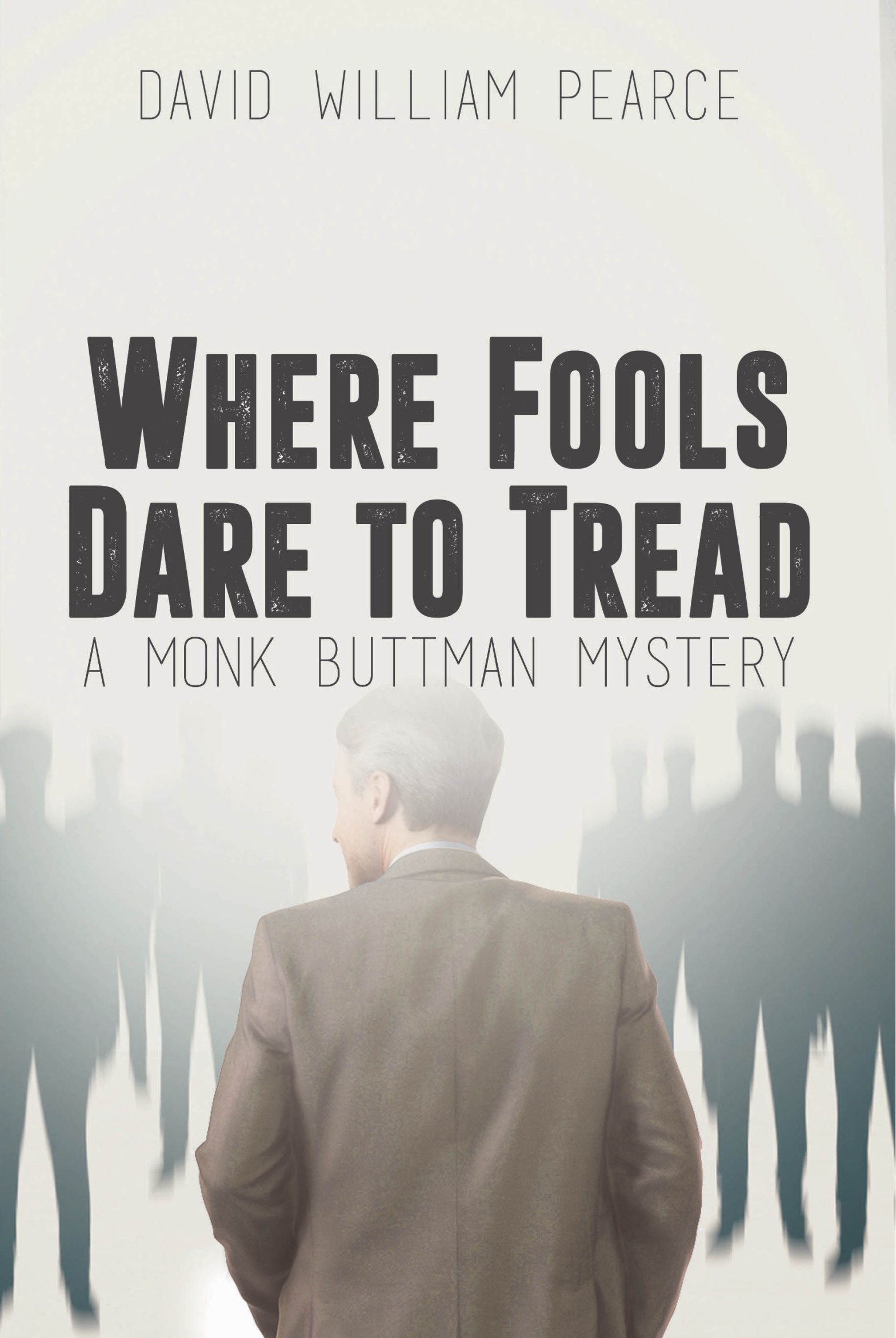
In my new book, Where Fools Dare to Tread, the main character, Monk Buttman, has no ambition other than living one day at a time in as uncomplicated way as possible, but actions outside his control overtake him and he is thrust into situations that he may not be able to manage. He is at the mercy of his intellect and guile and the forces he feels but cannot see, yet which he must navigate to survive.

The story came out of a love of noir, of pulp fiction, and of a regular guy stuck in someone else’s trap. I wanted him to have to confront what it was that led him to this simple anonymous life and the false proposition that somehow it would negate the pain and failures of the past, that they would dissolve in the shimmering heat of Los Angeles.

©2019 David William Pearce

Photo by Clem Onojeghuo at Pexels

Mr Jones

Mr. Jones is an associate of Monk’s in the loosest sense of the word. They were thrown together in the search for Desiree Marshan. Since then, they’ve become friends of a kind.

We were stuck in traffic, somewhere between West Covina and Long Beach. No doubt the signs would say where, but I’d lost interest in that. Jones was on his phone. The sun beat down on us in what had to be one hundred degree heat as we sat in my ’64 Ford Falcon. The top was down.

“I gotta ask…” I was tapping on the side of the car.

“Ask what?” Jones put his phone down.

“Aren’t you hot? It’s hotter than hell and you’re wearing nothing but black! Shirt. Tie. Suit. Sweat’s running off your head.” I could feel the sweat as it beaded across his shaved pate.

“It’s a state of mind, Buttman,” was his answer.

“A state of mind?”

“Are you deaf?”

“No.”

Jones shook his head, “It’s all in how you approach it, Buttman. Just because it’s hot doesn’t mean I have to give in and run around in a tee shirt and a pair of shorts. Besides, if you had a car from this century, there’d be AC and the hundred degree heat wouldn’t be a problem.”

“Then why didn’t you drive?” A perfectly legitimate question.

“The better question is why we’re even together!” His exasperation was showing.

“Because we weren’t smart enough to say no?”

“Speak for yourself, motherfucker.”

“Then it must be the stimulating conversations,” I offered.

“That’s what you got?”

“That’s what I got, motherfucker.”

Jones was stifling a grin, “You know I got a size and reach advantage over your sorry ass, right?”

I laughed at that. “Maybe.”

“Maybe?”

“See, stimulating conversations covering a range of topics…” I said.

“Like whether I can beat your ass?” he interrupted.

“Maybe.”

It was Jones’ turn to laugh.

The traffic jam began to break up and the movement along with a light breeze helped mitigate the heat.

Jones returned to his phone.

“Yeah, it’s me,” he said to whomever was on the other end. “I should be home soon. Yeah, I’m with Buttman.” He looked at me as I assumed Coretta, his wife, was speaking to him. “Cause I prefer Buttman to Monk,” he said. I shook my head. “Ok, love you too.” Jones put the phone in his pocket.

“Tell me again why I’m driving?” I was a little put out by the Buttman thing.

“Because I like havin’ me a white chauffeur, that’s why.”

I noticed the broad grin on his face.

“And you’re willing to sweat for it?” I snarked.

“It’s all a state of mind, Buttman, all a state of mind.”

Can’t argue with that!

©2019 David William Pearce

And Here We Are

My new book, my first published book, Where Fools dare to Tread,is now out and available through my publisher, Black Rose Writing. After patting myself on the back and shouting woo-hoo, I realized that now the overriding issue will be whether it sells.

As I am not a professional salesman, I find the sales and promotion aspects of being a writer fairly daunting because I don’t want to do it. That doesn’t mean I won’t, but I’m not preternaturally predisposed to such things. This doesn’t mean I don’t want to talk about the book or engage readers- I certainly do; it’s the “please buy my book” aspect that sends tingly sensations down my spine.

I understand that’s not terribly uncommon in writers.

In an alternate universe, a big book publisher would take care of promotion and tours and publicity and I could sit back and mingle with my people. For most of us, that doesn’t happen very often, and even to those to whom it does, there’s not guarantee of success.

So, I’m slowly wading into the sea of promotion. On the plus side, as I’m not self-published, there are the efforts of my publisher to go along with what I do, which isn’t that bad. I have blogs, and a Facebook page, as well as one on Goodreads, and I’ve made sure there’s something interesting on the Amazon author’s page besides the bare minimum. I have copies of the book on hand and I’ve invested in the software and hardware to sell a book should a prospective buyer be interested.

The next step is setting up an event or two at a bookstore which ought to be interesting.

I also have to keep writing.

©2019 David William Pearce

Rebekah Stops By

Rebekah is Monk’s somewhat estranged daughter, somewhat because she lives in Virginia and he’s out in LA. Throw in that he’s adverse to carrying a phone and she’s going through a rough patch in her marriage with her husband, Farrell, and the not so insignificant fact that they’ve seen little of one another in the six or so years since he left, and their relationship is tentative at best. Rebekah is stopping by after visiting her grandfather, Moses, who lives in Northern California.

“This is where you live?” Rebekah, my daughter, was not impressed with my quant little bungalow.

“This is it,” I said, confirming her impression. “Why, what did you expect?”

“I don’t know, something different, I guess.”

She stood at the door.

I didn’t expected her, hadn’t seen her in six years. My last memory of her is saying goodbye that sad summer’s eve and her rather blunt, “ok.” I sent my address, somewhat reluctantly, to her a few years back and expected nothing from it.

I assumed we were done with each other.

“Why don’t you come and have a seat,” I pointed to the small sofa across from the door.

“I can’t stay very long, my flight leaves in a few hours.”

If she had no time, why was she here? “You’re still welcome to have a seat for how ever long you can stay.”

Rebekah Jenkins, wife of Farrell Jenkins, moved past me and carefully sat down on the sofa.

“Would you like something to drink? I have water, wine, a few beers, and whiskey.” I offered.

Water is fine.”

I liked that I shocked her with an offer of whiskey.

With water in hand, I sat in the chair to her right. She removed the cap off the bottle, all the while regarding me. I knew I was different in both appearance and attitude, at least outwardly. Gone were the beard and the attitude. In place of denim overalls, I now wore suits of some vintage and I kept my face clean shaven. She probably didn’t recognize me.

“You seem to have changed everything about yourself. I asked for William Bohrman and no one knew the name. Then I remembered the name on the address you sent, Monk Buttman. Fortunately, a woman named Joanie pointed me here. ”

I wondered if Joanie was just outside the door trying to listen in.

“It’s true I don’t use the name William Bohrman anymore, but if you want to continue using it, that’s ok.”

“You mean like Astral?” she smiled at that. Astral was her mother’s name before she decided she preferred Lilith. I preferred Astral.

“Yes, like Astral. Speaking of which, how is your mother? Is she still with Judah?” I didn’t really want to know.

“They’re fine. She just delivered their third little boy.” I noted the sour tone in Rebekah’s voice.

“Really?”

“Yes.” Nice and terse, it was almost as if Astral were here.

“And you?”

“And me what?” she knew.

“Kids. I thought you were gung-ho to have children.”

Rebekah pursed her lips; I recognized the look, I had received it many times over the years. “We’re trying. For whatever reason we haven’t had any luck,” she looked directly at me as if it were my fault. She sounded like her mother after we tried to give her a brother or sister, insinuating the same, but I knew the truth to that lie. “Maybe God is testing us,” she murmured.

“Maybe.”

“What does that mean,” she shot back.

“Only that the mind of God can be difficult to discern, that’s all. How’s Farrell?” There was no point in arguing religion.

“He’s ok, he still works at the farm and feed with his brothers. He also leads a men’s bible study group at the church.” She got up and moved towards the kitchen. I followed.

“And what do you do these days?” I was curious.

“I have a job in town. It’s ok, I guess.” I noticed her looking at her hands.

“But…”

“But what?” Rebekah looked at me. I wondered if the day would ever come where I didn’t see anger or disappointment in her eyes.

“Nothing, it’s just that you don’t seem very thrilled.”

“Are you thrilled with your job? Actually, what is your job? I doubt it’s farming.” She stood on the other side of the dinette table I’d bought at the Goodwill.

“I work for a law firm, Aeschylus and Associates, and while I wouldn’t use the word thrilled, I’m content in what I do.”

“Yes, yes, everyone’s content.” She was back to looking at her hands.

“What do you mean?”

“It doesn’t mean anything.” I waited for more, but instead got, “I should probably go. Can you take me to the airport?”

“Sure.”

I reached over to the counter and grabbed a tissue.

©2019 David William Pearce

Joanie

Joanie is a neighbor of Monk’s and a one time flame for whom he continues to carry a torch. Theirs, oddly enough, is a codependent relationship .

“Are you coming or not?” Joanie was standing over me.

“You’re singing, right?”

“I told you that already! What’s up with you, Buttman?”

She was well aware of what was up with me.

“I want to make sure there’s something to entertain me other than you making googly eyes over this new guy,” I harrumphed.

“Oh brother, and his name is Mikal. I expect you to behave, Monk.”

I rolled my eyes, “Who do you think you are, Ardis?”

“Consider it a move out of Ardis’ playbook. Are you going to behave?”

I thought about it.

“Well?” she demanded.

“I always behave.” I didn’t care for the direction this conversation was taking. “You’re the one who wants me to make sure about the guy, remember?”

Joanie laughed. “You’re still mad about us aren’t you?”

“Mad is the wrong word. I simply think you’re making a mistake that’s all. You’ve got a perfectly good man right here. The idea that there’s something better is all in your head. I think it’s good to say that out loud. Plus it’s a perfectly good argument.”

“Uh-huh.” She leaned down and kissed me. “I warned you not to get attached to me, so no whining. We’ve talked about it many times and every time the answer is still the same, we had a fling, but that was all it was. We’re far better off this way than trying to make it as a couple. And you know that so stop whining.”

“I’m not whining,” I whined.

“You’re a lousy actor, Buttman.”

“I beg to differ.”

“I’m sure you do.” She was still standing over me. “Come on, get up, let’s go; it’s like pulling teeth with you.”

I stood up and straightened my suit and tie.

“That’s because you know nothing of acting. I see it as a sublime statement of your foolishness.”

“I’m sure you do. Let’s go.” She took my chair and placed it inside the front door. “You’re driving.”

“Really?”

“What?” she says.

“What? You spent most of yesterday complaining about being seen in an aging heap and now it’s ‘you drive?’” I could deal with the romance stuff since she was maybe eight-five percent correct, but I had to defend the honor of the Falcon.

“That,” she huffed, “was yesterday. Today it’s not so bad.”

“Uh-huh, what gives?” I locked the bungalow door and we walked to the street in front of the Moonlight Arms.

“Does your car have gas in it?” What a question!

I opened the car door for her. “Of course it does.”

“Well, mine doesn’t, so you’re driving.”

“That’s what it comes down with us now, is it?” I got in behind the wheel and started the car.

“That’s what it comes down to,” she said with more delight than was necessary.

“I don’t think that’s fair,” I mumbled.

Joanie leaned over and kissed my cheek.

“Probably not, but that’s us.”

That’s us!

©2019 David William Pearce